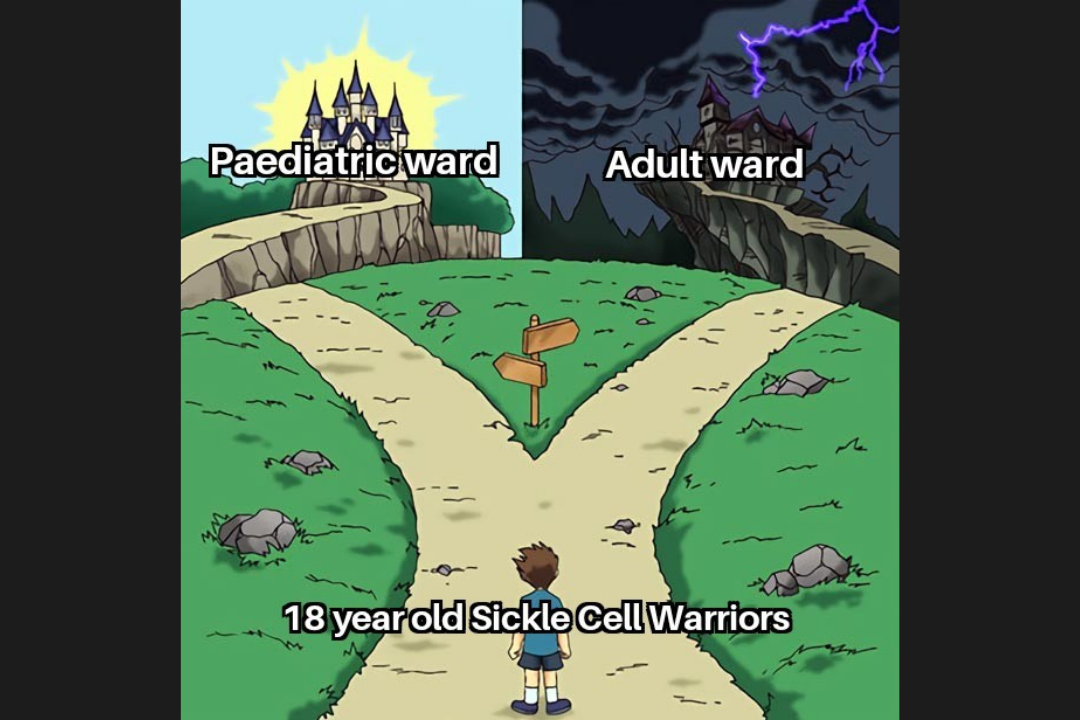

Some people with sickle cell are told the following in the emergency department:
"Your HbS is below 30 percent, so you can’t be having a crisis."
"This must be chronic pain."
"We need to limit opioids because this looks like opioid-induced hyperalgesia."
This reasoning is incorrect and harmful.
What a low HbS percentage actually means
If you're on regular exchange blood transfusions, your percentage of sickle Haemoglobin (HbS) is kept lower to reduce the overall risk of sickling.
A lower HbS percentage means the likelihood of a vaso-occlusive pain crisis (VOC) is reduced.
It does not mean the likelihood is zero.
There's no evidence that an HbS below 30 percent excludes an acute VOC.
What HbS does not tell clinicians
HbS percentage does not show:
%HbS is typically used as a risk marker for complications like strokes.
This is extracted from studies of population trends.
It was never meant to be used as a marker of real-time sickle pain or crisis detector.
Reduced risk does not equal a different diagnosis
This is where the most damaging leap often happens.
A reduced likelihood of VOC does not mean the patient must therefore be experiencing:
There's no test that allows clinicians to make that jump.
Chronic pain and opioid-induced hyperalgesia are diagnoses that require careful long term assessment. This should be based on an established trusting doctor-patient relationship.
Even then, in the emergency department the cause of acute pain can't be assumed purely because HbS is low.
Why vaso-occlusive crisis can still occur
Even with HbS below 30 percent:
Breakthrough vaso-occlusive crises are well recognised in people on regular exchange transfusion programmes.
They're not rare, unexpected, or controversial in haematology practice.
The role of patient lived experience
A vaso-occlusive crisis is a clinical diagnosis. This means there's no objective diagnostic test. It's made based on clinical judgement.
The most important part of that judgement is the patient’s report. If the pain:
This subjective experience is central to diagnosis.
Why under treating pain causes harm
When acute sickle pain is under treated:
Withholding adequate analgesia can actively worsen the biological processes driving a crisis.
Treating pain early and properly is not just humane, it prevents further complications.
What appropriate care should look like with known chronic pain
Example:
"You're on regular exchange transfusions and currently your HbS is below 30 percent"
"This reduces but doesn't eliminate the risk of vaso-occlusive crisis."
"You're reporting pain consistent with your usual VOC."
"We'll promptly treat this pain with an equivalent total opioid dose thats known to be effective for you and then reassess you fully."
This approach protects the patient and the clinician.
The key message:
A low HbS percentage reduces risk. It does not redefine the pain. It does not diagnose chronic pain. It does not justify withholding opioids. It does not overrule your lived experience.
Severe pain consistent with a vaso-occlusive crisis should be treated as a vaso-occlusive crisis, regardless of HbS percentage.
Stay Healthy,
Lewis