
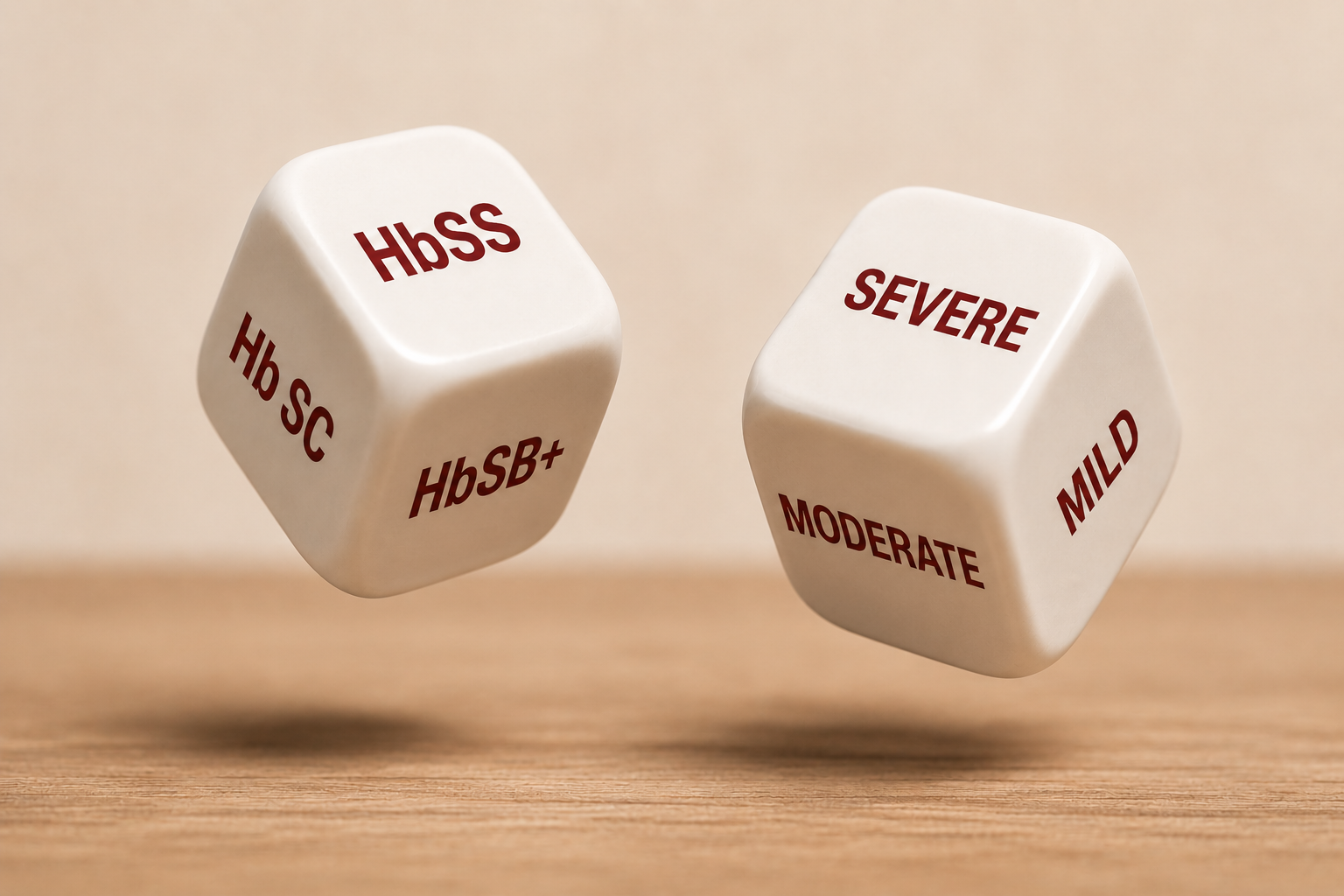
When you're diagnosed with sickle cell disease, one of the first questions is –
how serious will it be?
Whether through direct medical guidance or personal assumptions...
The answer is almost always based on genotype.
SS? Severe.
SC? Milder.
SBeta+ thalassaemia? Probably fine.
It's an understandable shortcut. Medicine loves categories.
But when that shortcut shapes which treatments people can access, it stops being a helpful framework and starts being a problem.
Your genotype tells us which type of sickle cell you have. Meaning which haemoglobin variants are present in your blood.
Your genotype cannot tell us is how those variants will behave in your body.
Two people with identical genotypes can have completely different lives.
One may rarely crisis. Another may be managing chronic pain, organ damage, and repeated hospital admissions.
This variability is well-recognised in SS disease. It's far less acknowledged in SC and SBeta+ thalassaemia.
I'm all for simplification but sometimes it can do real harm to people.
People living with SC genotype like myself can develop:
Avascular necrosis: a condition where bone tissue dies, causing chronic pain, disability, and requires major surgery to fix.
Retinopathy: where fragile blood vessels bleed into the eye and threaten vision.
Chronic kidney disease is a real risk too.
These aren't rare edge cases to be dismissed. They're the lived reality of a significant number of people with SC. The same applies to SBeta+ Thalassaemia.
Your phenotype (the way the disease actually shows up in your body) can be severe, even when the genotype label suggests otherwise.
Yet the research base for these so called 'mild genotypes' remains thin compared to SS.
This means clinical guidelines often don't reflect the full picture.
Bone marrow transplants and newer gene therapies are often gatekept by genotype rather than individual disease burden.
If your genotype is considered "mild", you may not be offered the same options - even if your actual experience of the disease is anything but mild.
This needs to change. More research into SC and SBeta+ thalassaemia is essential.
And in the meantime, clinicians need to look at the individual in front of them. Their complications. Their history. Their quality of life. Not just the label.
Your genotype is the starting point. It is not the whole story.
If you feel your severity isn't being taken seriously, you're not imagining it.
And you deserve care that reflects your reality.
Stay Healthy,
Lewis


